Philosophy
We foster relationships, both human and divine, knowing that all knowledge and faith find their true origin in God.
ICRS continually strives to be a genuinely Catholic School that deliberately and continually proclaims the Gospel.
We recognize parents as the primary educators of their children.
The dedicated staff of ICRS provides an excellent curriculum in academics, physical education and the arts which stimulates the growth of each individual in confidence, positive self image and personal responsibility.
Staff and parents are committed to preparing our students to live as citizens in service and leadership to their Christian community and the broader world community.
ICRS welcomes racial, ethnic, cultural and economic diversity among its families and strives to teach an appreciation of these differences to all students.
School-wide Learning Expectations
ICRS students are
1. Active persons of faith who
- live out gospel values of compassion and stewardship
- exhibit knowledge of Church teachings and practices
- pray personally and at liturgies
- guide decision-making with Catholic moral standards
2. Life-long learners who
- communicate clearly and effectively
- problem solve using critical thinking skills
- demonstrate good study skills and a strong academic foundation
- participate in creative arts and physical fitness
3. Active citizens of the global community who
- respect diversity
- work for the common good
- are aware of current events
4. Self-aware individuals who
- are accountable for their actions
- affirm self and others
History
Located in the beautiful Skagit Valley, Immaculate Conception School was created in 1945-1946. George Michael Dynes, William Hofstee, and Oscar R. LeCompte, members of the Skagit Board for the Catholic Children’s Service Bureau, together with the assistant pastor, Father William Grier, put together a plan for a Catholic School. With the arrival of Father Joseph Brennan as Pastor, the school was constructed as a parish school of Immaculate Conception Church.
Immaculate Conception School opened on September 13, 1949, with an enrollment of 131 pupils in Kindergarten through 8th grade. The school was solemnly blessed and dedicated by the Most Reverend Thomas A. Connolly on November 6, 1949, and opened under the direction of the Sisters of Saint Joseph of Newark, with six sisters commuting from Bellingham. The original structure contained five classrooms, an auditorium, offices, and custodial quarters. The first class of four students graduated the following year. The first lay teacher, Mrs. Jean Jansen, arrived in 1955 and served the school as sixth grade teacher and librarian for the next thirty years. When Father Patrick O’Brien became Pastor in February 1960, a fundraising drive was initiated to improve the church plant, pay off the school debt, and build a convent.
Historically, Immaculate Conception School operated as a parish school, yet parents’ perception was more of a regional school, as enrollment was comprised of students from many parishes. To broaden the financial base of the school, in 1996 the Skagit Valley parishes took on a greater authority and responsibility for the school through a governance agreement which established the school as a separate financial entity. To reflect this reorganization, the school’s name was changed to Immaculate Conception Regional School.
In 1987, the Immaculate Conception School Endowment Fund was established to enhance the long-term viability of Immaculate Conception School. The Endowment Board continues to oversee the investment of funds in order to provide the greatest possible return, while at the same time giving consideration to the safety of investment principal. The ICRS Endowment is managed by Mercer as part of the Fulcrum Foundation Consolidated Endowments. The Fulcrum Foundation supports Catholic education in the Archdiocese of Seattle. ICRS uses endowment distributions to support the annual budget and tuition assistance. As of 2026, the ICRS Endowment is worth over $7.2 million.
In the 1990s, a portable and a two-room building provided additional classrooms on the campus. In the summer of 1998, a ground-breaking ceremony was held for the St. Joseph Center. Since the center was named after the Sisters of St. Joseph of Peace, the community honored the Sisters of St. Joseph at the completion of the building and the celebration of the 50th anniversary of the school. This multi-purpose facility added three classrooms, a first-class area for the PE and music programs, as well as the opportunity to develop an athletic program. The building is also used for activities of the Skagit Valley Catholic Churches and is open for use by the greater Skagit Valley community.
To date, fifteen women have served as principal of the school: Sister Mary Norbert Martin from 1949 to 1952; Sister Rosalie Dumont from 1952 to 1955; Sister Margaret Dove from 1955 to 1961; Sister Agnes Joseph Bates from 1961 to 1962; Sister Marguerite Morrissey from 1962 to 1965; Sister Verona Egan from 1965 to 1968; Sister Una McCourtney from 1968 to 1982; Sister Angela McCarthy from 1982 to 1994; Sister Elizabeth Linnane from 1994 to 1995; Sister Mary Shau from 1995 to 1998; Sally Merryweather from 1998 to 2001; Jean Champagne from 2001 to 2002; Kathy Cartee from 2002 to 2011; Ann Leichleiter from 2010 to 2013; Gwen Rodrigues from 2013 to 2022; and Sarah Rutherford from 2022 to present. Sister Elizabeth was the last sister of Saint Joseph to work at Immaculate Conception Regional School.
Throughout its history, ICRS parents and stakeholders have been instrumental in school leadership, including membership on the School Commission, Finance Council, Facilities Committee, Technology Committee, Safety Committee, and Endowment board. Theses committees ensure the long-term health of the school, including the physical plant, finances, best practices, and fidelity to our Catholic faith.
In 2024, ICRS celebrated its 75th anniversary. The community gathered to honor the Sisters of St. Joseph of Peace, benefactors, and alumni.
Accreditation
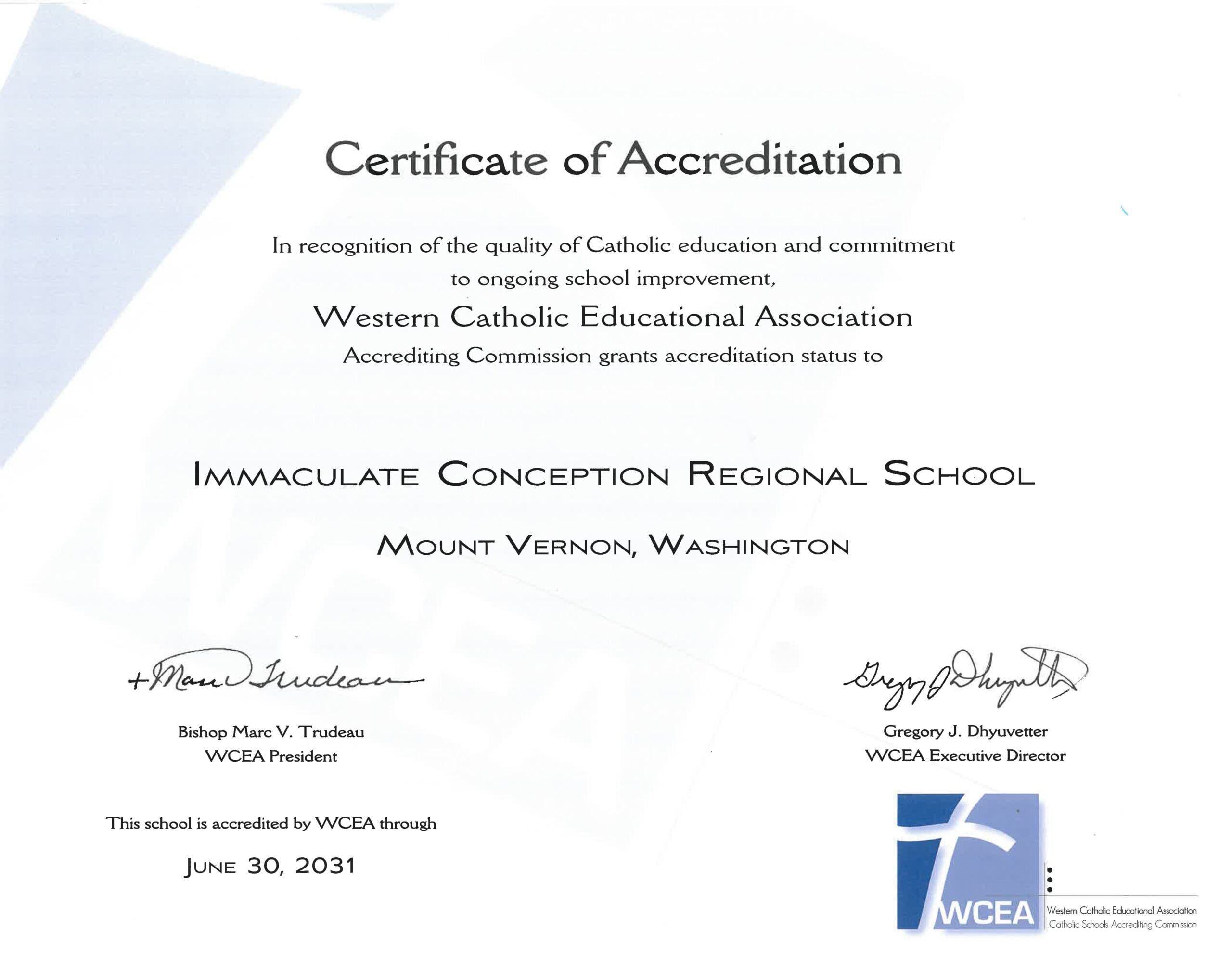
Immaculate Conception Regional School is an accredited member of the Western Catholic Educational Association (WCEA), reflecting our commitment to excellence in Catholic education and our accountability to the families and community we serve.
A Continuous Cycle of Improvement
Under the guidance of the Office of Catholic Schools in the Archdiocese of Seattle, ICRS participates in a rigorous, ongoing six-year accreditation cycle designed to ensure that our school is continuously growing and improving. The process unfolds in three phases:
1. Comprehensive Self-Study
Every six years, ICRS conducts an in-depth self-study involving all stakeholders — parents, students, staff, and community members. Input is gathered and evaluated across four domains:
- Mission and Catholic Identity — Are we living out our Catholic mission in all aspects of school life?
- Governance and Leadership — Is our school led with integrity, transparency, and effectiveness?
- Academic Excellence — Are we providing a rigorous, high-quality education that prepares students for success?
- Operational Vitality — Are our facilities, finances, and operations healthy and sustainable?
2. External Evaluation
Following the self-study, an independent evaluation team visits ICRS to assess the school’s findings, observe our community in action, and provide professional feedback and recommendations.
3. School Improvement Plan
Using the self-study and evaluator feedback, the ICRS community collaborates to create a School Improvement Plan — a concrete, goal-driven roadmap that guides the school’s growth and development over the following five years, until the accreditation cycle begins again.
Why It Matters
Accreditation is more than a credential — it is an ongoing promise to our families that ICRS holds itself to the highest standards of Catholic education. It ensures that we are not only meeting expectations today, but actively planning for an even stronger tomorrow.